Friday, September 24, 2010

Old, White Books

I freaking love Costco. Not everything on the shelves is a steal, but their books always are. Actually, the books are priced so low I feel guilty buying them. What, Jon Krakauer’s Where Men Win Glory for $9.84?!? I couldn't pass that up. I felt like I was stealing it for that price. Thanks, Jon. If you leave me your address I will send you a few more bucks in the mail. The guilt I feel from buying a book for that cheap does do its job. I have only bought three books at Costco since I became a lifelong member a couple of years ago.

It doesn’t matter whether I am going to Costco for two two-liter jugs of olive oil or for an 8 lb. bag of frozen strawberries, I will always peruse through the limited and seemingly illegally priced books. Today, I noticed with glee that Jon Stewart’s Earth (currently #1 on Amazon.com) was prominently featured at the end of the book display. I didn’t buy it, not for $15.94, or something like that. All I know is that it was marked at least ten dollars below the MSRP. Anyway, I walk over to the display and lay my hands on Earth. I stand there and flip through the book for a good ten minutes, reading paragraphs here and there and even eyeing a picture of a three-breasted woman (as seen in Total Recall) and deciding, once and for all, I much prefer two.

While I am looking through the book, I notice the two other books placed at the end of the table, Bill O’Reilly’s Pinheads and Patriots (currently #40 on Amazon.com) and David Limbaugh’s (yes, that Limbaugh’s brother) laughably titled Crimes Against Liberty (currently #35 on Amazon.com). Seriously, all I can do when seeing a book like Crimes Against Liberty is laugh. I can’t even open it up. That would be giving it an honor it doesn’t deserve.

When I first ventured into Costco as a member, I noticed right away, without surprise, that the majority of their political books are from conservative authors. So, it was, also without surprise, that when I stood there, looking at Earth, only one other person picked up the book to look at it while a number of Pinheads and Patriots were thrown into shopping carts and one copy of Crimes Against Liberty was toted off. As I watched pinhead, err shopper after shopper step up to the mountain of right-wing books I couldn’t help but notice a stereotype being strongly reinforced. The buyers were all older, white males who looked grumpy and gazed upon O’Reilly’s latest like it was the Bible…every single one of them. Were they also looking at me and feeling like a stereotype was being strongly reinforced? Young, white male in shorts and flip-flops who is jobless and who is probably going to go smoke a bowl after this and then maybe come back a couple hours from now for some free samples because he has got the munchies.

Will I become like them? I hope not. And as O’Reilly’s book continued to find its way into the shopping carts of octogenarians, I walked out of Costco empty-handed, went home, made lunch and special brownies…I kid, I kid…and readied for work tomorrow.

Colbert in D.C.

Stephen Colbert Speaks at a Congressional Hearing...in character. Worth the watch. VIA TPM.

Thursday, September 23, 2010

Stories From Rwanda

I first heard about We Wish to Inform You That Tomorrow We Will be Killed With Our Families: Stories From Rwanda (by Philip Gourevitch) in college. Somewhat predictably, it was Aaron who suggested I read it and, like so many suggestions I receive, it took me years to get around to reading this book. I finally have, finishing it up last week and now I am passing on the suggestion to anyone who happens to check my blog and have an interest in such things, even if that thing is genocide in Rwanda. Even before opening the book up, I was trying to prepare myself for what I would encounter on the pages within. I was also trying to put into words why it was that I wanted to read about an event I already knew didn’t end well and then Gourevitch presented me with this paragraph:

Like Leontius, the young Athenian in Plato, I presume that you are reading this because you desire a closer look, and that you, too, are properly disturbed by your curiosity. Perhaps, in examining this extremity with me, you hope for some understanding, some insight, some flicker of self-knowledge—a moral, or a lesson or a clue about how to behave in this world: some such information. I don’t discount the possibility, but when it comes to genocide, you already know right from wrong. The best reason I have come up with for looking closely into Rwanda’s stories is that ignoring them makes me even more uncomfortable about existence and my place in it. The horror, as horror, interests me only insofar as a precise memory of the offense is necessary to understand its legacy.

This was the best-worded explanation of my desire to know about the genocide in Rwanda and similar tragedies. So, I read on, learning so much about the history of Rwanda, its people, and the players in the genocide, which proved to be the most efficient mass killing of human beings in modern history. Some estimates put the number of dead at one million, but it is clear that at least 800,000 people died in a three and a half month stretch in Rwanda.

From what I understand, the roots of the conflict—at least one of them—can be traced back to white Europeans, who, upon arriving in Rwanda, treated the minority Tutsis like they were significantly better in all ways than Hutus because they [Tutsis] more closely resembled—at least according to John Hanning Speke—a “Caucasoid tribe of Ethiopian origin, descended from the biblical King David, and therefore a superior race to the native Negroids.” From there on, things only get more complicated and it is pointless to elaborate when Gourevitch does it so well.

As a whole, the Western world is guilty when it comes to the genocide in Rwanda, but I didn’t know how France essentially enabled and prolonged the conflict by providing arms that they knew were being sent across the border to the interahamwe, a Hutu paramilitary organization responsible for much of the slaughter in 1994. Gourevitch points out that “In 1994, during the height of the extermination campaign in Rwanda, as Paris airlifted arms to Mobutu’s intermediares in eastern Zaire for direct transfer across the border to the genocidaires, France’s President Francois Mitterand said—as the newspaper Figaro later reported it—“In such countries, genocide is not too important.” By their actions and inactions, at the time and in the years that followed, the rest of the major powers indicated that they agreed.”

Perhaps I am naïve in assuming it is common knowledge that the West ignored the genocide in Rwanda. So it shouldn’t be shocking when the reader is reminded again and again of the West’s blunt refusal to aid Rwanda and to call what was going on within its borders genocide, but it was, both genocide and disturbing that everyone just stood by. Gourevitch keenly reminds us of this, all the while highlighting the Westerners who attempted to stop the genocide, like Lieutenant-General Dallaire, the Force Commander of UNAMIR, the United Nations peacekeeping force for Rwanda in 1993 and 1994, who went on Canadian television in 1997 and said, among other things:

Essentially, how many people really still remember the genocide in Rwanda? We know the genocide of the Second World War because the whole outfit was involved. But who really is involved in the Rwandan genocide? Who comprehends that more people were killed, injured, and displaced in three and a half months in Rwanda than in the whole of the Yugoslavian campaign in which we poured sixty thousand troops and the whole of the Western world was there, and we’re pouring billions in there, still trying to solve the problem. How much is really being done to solve the Rwandan problem? Who is grieving for Rwanda and really living it and living with the consequences? I mean, there are hundreds of Rwandans whom I knew personally whom I found slaughtered with their families complete—and bodies up to here—villages totally wiped out … and we made all that information available daily and the international community kept watching.

In fact, the international community paid little attention until the peak of the genocide had passed and thousands of Rwandans had wound up in refugee camps. These refugee camps were exactly what the Western media were looking for in terms of something they thought would make great television. Relatively accessible and not too graphic to show on TV, the refugee camps became the popular cause, raking in thousands of dollars in support and hundreds of volunteer organizations. What wasn’t reported is that a very large percentage of the refugees were Hutus who had fled Rwanda after killing their Tutsi friends, neighbors and co-workers. The camps were packed with murderers and now they were the ones benefitting from Western aid and support while their dead Tutsi compatriots fertilized Rwandan soil. No one reporting on the refugee camps knew the whole story or that Hutu Power organizations were allowed to flourish within the refugee camps. So the genocide continued and volunteers tended to many who committed the worst atrocities.

At one point in the book Gourevitch tells a story of a reporter “who was sent into Goma directly from Bosnia” to report on the refugee camps. The reporter told Gourevitch that “he knew what Hutu Power was and that he looked up at the volcano and prayed, “God, if that thing erupts right now, and buries the killers, I will believe that you are just and I will go to church again every day of my life.”

You could write a lengthy paper surmising about all the reasons for the West’s ignoring the genocide in Rwanda. There are many, but one from the book that stuck out is this, given by Bonaventure Nyibizi, “You cannot count on the international community unless you’re rich, and we are not. We don’t have oil, so it doesn’t matter that we have blood, or that we are human beings.” This is worth pondering. If Rwanda were rich in oil and if it was a big exporter to the United States, would the genocide have been allowed to go on for months? I highly doubt it.

The United States was slow to confess that they were guilty of inaction. Toward the end of the book, Gourevitch offers up this tale of Clinton’s visit to Rwanda in March of 1998:

If Rwanda’s experience could be said to carry any lessons for the world, it was that endangered peoples who depend on the international community for physical protection stand defenseless. On the morning of Albright’s visit to Rwanda in December, Hutu Power terrorists, shouting “Kill the cockroaches,” had hacked, bludgeoned, and shot to death more than three hundred Tutsis at an encampment in the northwest, and in the days before Clinton’s arrival in Kigali, as many as fifty Tutsis were killed in similar massacres. Against such a backdrop, Clinton’s pledge to “work as partners with Rwanda to end this violence” sounded deliberately vague.

Really, We Wish To Inform You…, is a book about two atrocities: the genocide in Rwanda and the West’s inaction to stop that genocide. You become familiar with the stories of many Rwandans, Hutus and Tutsis, and how they survive now, trying to move on and how some find that to be impossible. And by the end, there is a hint of a generation who makes no distinction between Hutu and Tutsi, a generation who calls themselves Rwandans and nothing else.

Gourevitch, Philip. We Wish to Inform You That Tomorrow We Will be Killed With Our Families: Stories from Rwanda. New York, NY. Picador, 1999.

Wednesday, September 22, 2010

Failing to Repeal Don't Ask, Don't Tell

Here is what I am thinking, anyone who is willing to:

…Fight a war for this country…

…Risk stepping on a landmine…

…Risk picking up a rock with an IED beneath it ready to blow their leg off…

…Risk being an amputee or handicapped for the rest of their lives…

…Risk being kidnapped by terrorists and having their head chopped off…

…Endure sleeping in a dirt hole for months at a time…

…Endure regular daily temperatures of 120 degrees and above…

…Have a shitty haircut…

…Be separated from spouses, kids and family for 12-15 months at a time…

…Carry 80 pounds of war gear on their backs for days and weeks and months…


…Deserves to be open about their sexuality. Why should they live a lie and live in fear among their fellow soldiers and commanding officers when they are willing to do all the above and more? I want the Democrats and Republicans who voted no on the defense authorization bill yesterday to give us one good reason why they voted no. Just one good reason. I haven’t heard any.

Monday, September 20, 2010

Documenting a Beatdown

Unfortunately, it felt like Boise State was welcoming Wyoming to the Mountain West Conference with a beatdown on Saturday, when, in fact, it will be Boise State who officially joins the Mountain West next year after their last season as a member of the WAC (a considerably weaker football conference). It was great being back in Laramie for a football game. The weather couldn't have been better. It was a sellout and the newly renovated War Memorial Stadium was as rowdy as ever. I just wish I saw a slightly different game. The images below document the evening.

The eastern stands got a club level over the summer, significantly improving the appearance of the stadium and they still welcome you to 7,220 feet.

Good to see a sea of brown and gold in the student section.

And so it begins...8:30 left in the first quarter and it is 10-0, Boise State.

Note change in score, slight change in time and no change in quarter.

All night long, Boise State QB finds wide open man.

Getting a little distracted by now...taking photos of the west stands.

Important numbers here. Look closely at Wyoming's Rush YDS (-30) and Total YDS (1) with 39 seconds left in the first quarter. Note Boise State's Total YDS (214).

Barely into the second quarter. 24-0.

At least there was a pretty sunset to look at. We didn't quite stay till the end, but we had seen enough with 6 minutes left in the game. Final score: Boise State 51, Wyoming 6. We did get a touchdown but we were denied the PAT. In their summary, ESPN says it was over when Kellen Moore (QB) and the Broncos started needing style points to impress BCS voters. They must be referring to the flip by this Broncos player as seen in the video below at 1:10. On a different day, I believe Wyoming could put up a better fight, but after a loss like this it is important to remember Boise State's recent successes on the national stage and their ranking (currently 3rd in the country).


Friday, September 17, 2010

Boise State @ Wyoming

I'll be in Laramie over the weekend. We are heading up tomorrow to see Wyoming take on Boise State in football. You probably just cringed. I am used to the cringing and wincing, like you just got punched in the kidney. It is the natural reaction from hearing Wyoming will play Boise State, but Wyoming better get used to it because starting next year the Broncos are going to be in the Mountain West.
I don't expect a great, close game. But you never know what can happen at home. It's a night game. It's a sellout. Time to mount up, Cowboys. Don't let the Broncos buck you too hard.

Thursday, September 16, 2010

Lost and Character Development

Instead of trying to do one mega post about Lost I am going to do several smaller posts. I figure they will be easier to read and digest and a little easier to write. So let’s get it on. I am telling you now, don’t read on if you want to watch Lost now or at any point in the future. I wouldn’t want to spoil anything for you.

In a previous post on this blog, I hinted at the ability of the writers to make me love and hate each and every person on the island. I went through phases of whom I hated. First, it was Sawyer (also James, but I will refer to him as Sawyer from here on out). Then it was Kate and then it was Shannon and then it was Sawyer again. The point being, I felt like I needed a whole two seasons to really know who I could trust like I was on the island myself, fighting for a way off.

Lost begins with an eye opening (literally) and a plane crash on a seemingly deserted island. The struggle is established right away, an advantage not all stories have. Because of this, the writers could start character development right away with stories and flashbacks from each and every actor of the enormous cast. I was learning as much about the history of the survivors on the island as I was about their struggle to get off it. Since character development occurred so early in Lost, by the end of the second season there was a plethora of characters you knew better than characters from other TV series you may have been watching for twice as long.

Consider Mr. Eko, who appeared in 27 episodes. Mr. Eko was a deeply religious character who had converted to Christianity after his previous life as a drug lord had led to the shooting of his younger brother, who just so happened to be a priest who had died (as a result of the shooting) during a flight or upon crash-landing on the island himself, the same island Eko would later crash-land on. In his childhood, Eko saved his brother from being a child soldier in Africa. Rebels had come to the village in which Eko and his brother lived. They had corralled the kids and were trying to make Eko’s brother shoot an unarmed man. This was an initiation, which Eko would not let pass. He stepped in, took the gun from his brother and promptly shot the unarmed man. The rebels loaded Eko up in a truck and from that point, until much later in his life, he was a killer, a child soldier forced into horrific situations beyond imagination. And he did all this so his brother wouldn’t have to. Eko knew, even as a young boy, that he was sacrificing his innocence and, perhaps, salvation in order to save his brother. And this is just information we are given about Eko’s time before he was on the island.

On the island, Eko is at first an enforcer in the second surviving group from Oceanic 815. He was peculiarly quiet and very intimidating considering his size, demeanor and the club he wheeled around, which he would occasionally inscribe the numbers to Bible verses on. Eko the enforcer, soon becomes Eko the protector, and someone who has the power to put a leash on Ana Lucia (the self-proclaimed leader of the second surviving group) when she goes on another power trip. Upon the union of the two groups of survivors, Eko becomes a good friend to John Locke and Charlie. He believes, even before he finds his dead brother, that he was brought to the island for a reason. He feels a spiritual connection to the island, even if he doesn’t know exactly what it is that will meet him in the jungle. Eko starts to see things on the island, things that only Eko can see. For example, his dead brother helps him find another hatch. Although a devout man, Eko doesn’t seem to believe in his forgiveness. He is constantly in pursuit of it and when he starts to see his brother’s ghost on the island he views following the ghost as a means to an end, his regaining of that innocence he lost when he shot the unarmed man so many years ago in his village.

And then, just when you thought Eko might be there to the end, he is killed off with little explanation. We learn later on that the person he thought was his brother wasn’t necessarily always his brother, but that’s not the point. The point of all this is that Eko is an amazingly deep character with a tragic arc you could make a movie out of, but on Lost, he was one of many developed characters and all of a sudden he was dead. I have never watched a show where so much time was spent on character development. It must have been a luxury for the writers to know that when they killed Eko off, they had another 16 or so characters that would still be around and each one of those characters had their own complex history and story that needed to be fleshed out. Eko’s death was probably very difficult to write and it was a disappointment to see him go, but he was a pawn in a much larger story and although the writers never made me hate him, even temporarily, I understood why he had to go. But like many events on the show, I didn’t truly understand their purpose until the end.

Tuesday, September 14, 2010

September Sunsets

Every night I am home it is hard not to take pictures of sunsets. I don't want to pass up an opportunity, but I also don't want to fill my hard drive with sunset pictures, which can get a little repetitive. However, I like these shots, especially the last one of Kate. No doubt, Colorado sunsets are some of the best.


Monday, September 13, 2010

The End of Lost

For most fans, the end of Lost was on May 23, 2010. It was just a couple nights ago that Kate and I watched four episodes, one of which was almost two hours, keeping us up way past our bedtime, in a binge of Lost-watching that will not be matched by us because the show is over. I have been thinking about the show since we finished it. There is a lot to examine and opine about, but I am working on that.
Honestly, Lost is on par with Star Wars and The Lord of the Rings. Easily. Easily. And to think, it came from television, a fact worth mulling over for hours. On top of that, I once doubted--just a little bit--the quality of the show because of the mass following and the insane devotion of its viewers, who, I have discovered, were not mistaken in their appreciation for and addiction to this show.

The scope and breadth of Lost is one of its most attractive traits. Although I consider it to be as great as Star Wars and LotR, Lost invites a broader swath of the public to be its viewers because of what the show addresses, which is considerably more than a movie can do, even if there are six (SW) or three (LotR) of them. In my next posts about the show, I will write about those things the show addresses and I will do so by sharing much of the plot. This is to say, if you ever want to watch Lost, don't read any more blogs about the show (at least on this blog). Instead, jump right in on Hulu (seasons 1-5 are free until the end of the year) or start renting them.

Article about J. Stew

I haven't even finished reading it, but there is an interesting profile of Jon Stewart at nymag.com and why his brand of comedy/satire/dare I say, journalism is thriving right now.
Worth a read if you feel strongly, one way or another, about the show.

Friday, September 10, 2010

They Facebook?

I quietly signed back onto Facebook a couple weeks ago. I am thinking of my return to Facebook as a trial period, which will either remind me of how stupid it all is or show me some great things about it, which I might not have noticed the first time around.

An observation I have made since signing back on is that the average age of Facebook’s users has skyrocketed. During my two-year hiatus, at least one aunt of mine joined, an in-law joined, and countless adults, people who I didn’t know could even use a computer, joined.

In a way, seeing all the old people on Facebook is sort of sad, but cool also. Sad because Facebook used to belong to twenty-somethings, it was a little corner of the internet for us, like a club, albeit a very impersonal and lame one, for wrinkle-free human beings. And cool, because you realize that older people do catch on to trends in technology, even if by the time they get to them the trends are quite dusty and in need of repairs.

Thursday, September 09, 2010

Trabajo

I got a job with that fruit company Forrest Gump invested with, the company which sent him a letter saying he didn't have to work another day in his life if he didn't want to. Well, that's not the case for me, but that's okay. I am excited and more than ready to do some work.

Wednesday, September 08, 2010

Dear Milwaukee,

My first memory of you, not necessarily the first time I was visiting you, but the first time I realized this was where we were making our home was in May of 2007. Kate and I came out to you and we tried to find a place to live. The weekend is a blur, but I remember the heat and the humidity. It was like the jungle. I kept saying to myself, “This is just for a year.” We stayed for three. If only I knew then what I know now about you.

You are surprising in every way. I wish you got to surprise more people. I leave you having not shared you with anyone besides a few family members. You are our little secret; three years of our lives will be unknown to my friends and even family members. Only our parents will know what we refer to when we talk about the beach in Milwaukee or Alterra or a restaurant called Carnevor. I am still sad about all that. Someone once referred to it as stubbornness. It is not that. It was a desire to have people visit us in our new home. We leave holding you dearer in our hearts than we could have imagined. And we are the sole keepers of these three years and that is an important task for us for there are fewer people to ferry these memories into our next community and tomorrow’s conversations.

Milwaukee, you gave us hard times and we were recipients of bad news over and over again while we resided within your borders. You made us feel a world away when we wanted to be next door. Had we not been a thousand miles away I would have gotten into trouble, thrown a couple of punches and might have defaced a church. I often daydreamed of it and you kept me from those releases of bitterness and anger. I have stored those away for now. Occasionally, they poison me and I feel some anger rise up and I wonder, will moving back renew some of that? I don’t want it to, but it isn’t out of the question. Returning to the source of your demons forces you to confront them. And Milwaukee, you prepared me for that. I am more able because I have felt a greater depth of pain and disappointment here than I had ever felt before.

But I have also felt and known a deeper love, a greater respect for life and its wickedly beautiful and tortuous twists, like the day I realized I love you. I thought it would never happen, but that idea took a beating from so many people, places and things. The walks with my wife on the shores of Lake Michigan, the once untapped city at our fingertips, the friends we made, the team I grew to love, the championship, immersing myself once again in the wonderful world of swimming and the coaches who coached beside me, and the lovely upper-Midwest touches of humidity, cheese, fish fries and snow on the ground for months; all of these things built up a love for you. I will miss the color green and the abundance of it here, the green screaming from the forest’s edge, forest of the likes I hadn’t seen since 1991 in New Jersey, a forest you can’t find in Colorado. Impenetrable. A massive, verdant wall.

Your inhabitants are one of a kind, Milwaukee. With 1.5 million people, you are diverse like any other big city, but nearly all of your inhabitants are native to the state and, on a larger scale, the Midwest. I’ve never encountered so many people so unhappy with their hometown. Not that you are bad, you are lovely, but there is just this propensity for Midwesterners to stay put. Moving out of state is not something your people do. They exude a sense of duty and loyalty to you even though they want to leave, even though they seem envious of people moving on and moving out. Yours is a grounded people. Happy and sometimes frustrated with you, but not going anywhere, even for a little while, because the Midwest is where they live, where they will always live, and that is fine with them…for the most part.

Milwaukeeans are fiercely loyal to you. You should be proud. From your boring Brewers to your agonizingly overrated Summerfest, there is no shortage of fans. No one tailgates like you do before every single Brewers’ home game. Mini grills and a lot of crappy beer being drunk. That is another thing your people are astonishingly proud of—the crappy beer. You are a beer city, but a domestic beer city. Yes, you have standout joints like Café Centraal and the Sugar Maple, where you can’t find someone drinking an MGD, but your lifeblood is Miller Lite, High Life, Milwaukee’s Best and something called Schlitz. This is what your people run on and that humors me because I think there is so much more out there to experience in the beer world, but I know that your people don’t care. They are unwavering in their devotion to you and your products. It is beauty that I can raise an eyebrow at and simultaneously deeply respect.

I didn’t cry when I left you, I cried when I realized I was going to leave you. It was months before July 29, when I was driving to work over the Hoan bridge and it was a crystal clear day with the skyline in front of me, Lake Michigan to the right and I-94 far below me, weaving westward to the horizon. I didn’t just remember the last three years at that moment; I felt them wrapping around me, pulsing through me at the speed of light, like a wave crashing over me, flipping me end over end over end and whatever thought filled my head last made me smile and shed a tear.

Milwaukee, I learned so much while I was within your borders. I thought I knew a decent amount about life when I arrived in the upper Midwest. I thought I had some crap figured out. I didn’t. Life only got more confusing, but you helped it become more beautiful too. Kate and I will be lucky to find that again. You will always be our first home and you will always be missed, no matter how many smiles our new home brings us.

I love you.

Monday, August 30, 2010

Mt Evans - 14,264 Feet

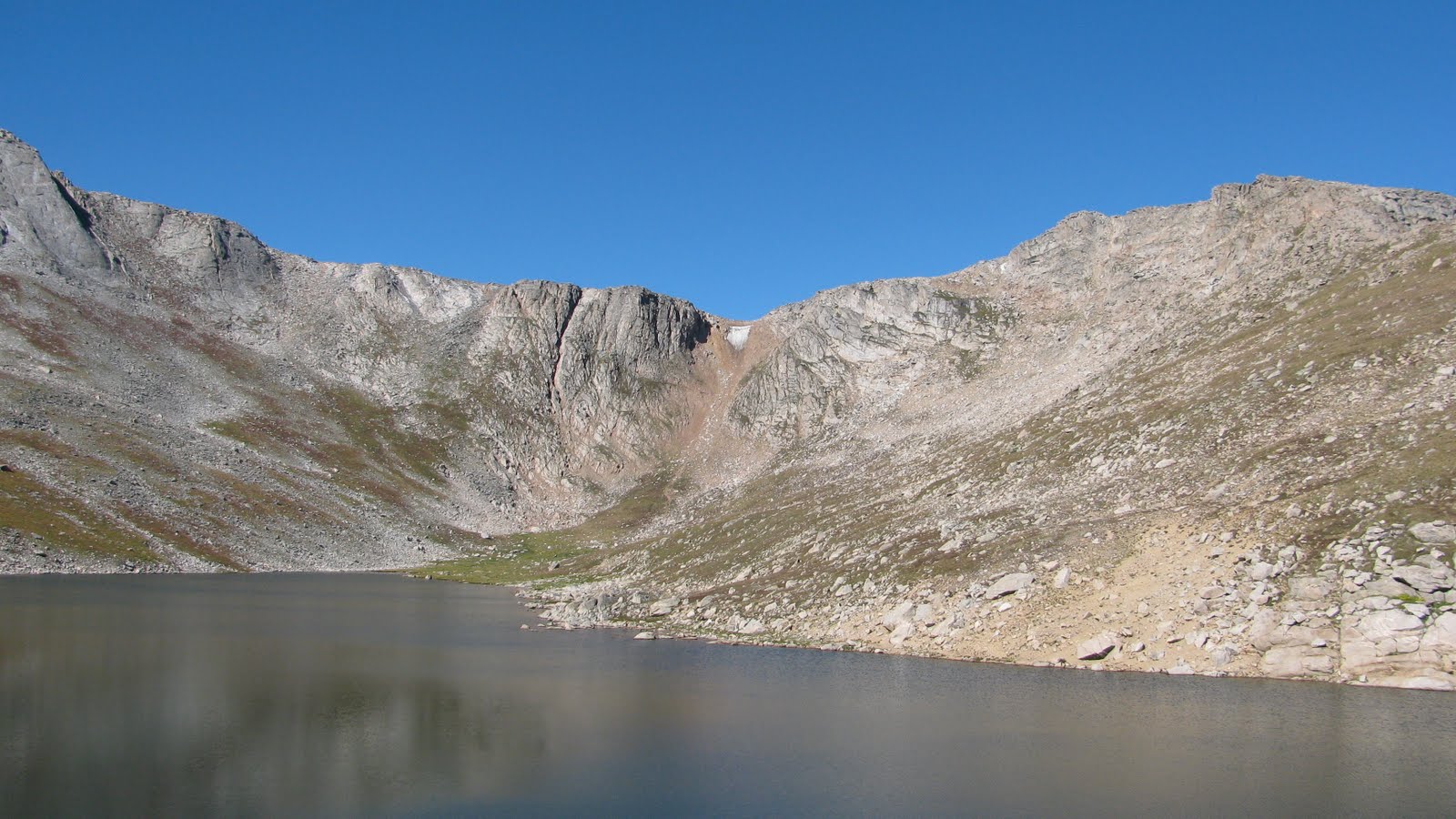
Kate had a day off on Thursday and we drove on the highest paved road in North America, the Mt. Evans Scenic Byway, which tops out at a parking lot right below the summit. The parking lot is at 14,140 feet roughly. It is a short five minute hike to the summit at 14,264 feet. The view was spectacular. From the top we were able to spot our apartment tower in Denver with binoculars. While we were up there I spoke with two hikers who had started out on the trail at 6:30am and had just made the summit five hours later. I admired them, not for climbing a 14er, but for climbing one you can drive up. I wouldn't want to spend five or more hours on a trail only to find a parking lot at the top. How depressing. I think that sort of defeats the purpose. However, I would highly recommend the drive if you haven't done it. The road closes September 7th. It is a bit of a hairy drive with skinny lanes, no guardrails, and huge consequences if you take your eye off the road for one moment. Here are some shots.

On the way up. There were a lot of views like this where it felt like you were just driving up and off the earth.

Summit Lake on the way up to Mt. Evans.

Long's Peak can be seen in the center of this picture. It wasn't the clearest day and I forgot my big zoom lens at home so this will have to do.

Summit Lake as seen from the summit right next to a substantial drop off.

On the edge, shooting straight down.

I am not familiar with all the names of the surrounding mountains and ridges, but I believe this is part of the Sawtooth ridge, just west of Mt. Evans. You hike this ridge to get to the summit of Evans. A climber can be seen at the top of the ridge.

Bryce and Kate. Back in Colorado, coming to a Christmas card near you.

I don't know my wildlife, but some type of mountain goat here, munching on poop (unconfirmed, but probable) on the side of the road.

On the way down now, Kate leaned out the window and snapped this shot of the road, winding upward on the eastern slope of Mt. Evans.

One hell of a drop. This was Kate's view as I drove us down the mountain.

Tuesday, August 24, 2010

M.I.A.

I've been working on a longer post about my three years in Milwaukee. I was hoping to have that be the first post from Denver, but I am not done with it and it is hard to make time for writing right now. For now, let me explain that I have been M.I.A. due to our recent move to Denver and the hectic nature of moving all one's belongings 1,100 miles. I will be back with some regularity soon. Here are a couple pictures of a recent sunset as seen from our new digs in Denver.


Thursday, July 22, 2010

2-3 Inches Of Rain An Hour

Milwaukee just got seven inches of rain in two and a half hours and multiple tornado warnings. This is something I will miss about the Midwest...it sure does know how to throw a thunderstorm. It was a good send-off.

Plays With Sparklers

I attended a wedding over the 4th and there were sparklers at the reception. This is proof.


Sunday, July 18, 2010

Just Do It

Proof that there are good ads on TV. I love this commercial. It gives me goosebumps.

Saturday, July 17, 2010

NatGeo Photo Update

I found my photo on NatGeo's Daily Dozen. I thought it had been lost or taken down or determined to be unworthy. It has magically reappeared in June - Week 5. I know some of you went looking for it and probably determined I was lying. Be sure to look through all the photos and keep coming back because there are some amazing shots.

Thursday, July 15, 2010

Inception, Lost, LeBron and Le Tour

The movie I can’t wait to see…Inception. I can’t wait to see this on the big screen. Seeing previews for it is exactly like seeing previews for The Matrix back in 1999. You didn’t really know what the hell the movie was about, but it looked so damn cool. Don’t let me down Inception.

The TV show I can’t stop watching…Lost. For six years I had this conversation with people. It always started and ended the same way.

Friend: Do you watch Lost?

Bryce: No.

Friend: Oh, it is so good. You would like it.

Bryce: I bet I would, but I just don’t want to get into it now.

Friend: You should. You would get hooked.

Bryce: I don’t want to watch another series on TV. When Lost is done, I’ll watch the series straight through. It will be better that way and besides, I have never seen an episode and am so far behind.

Well, Lost is done and I am blazing my way through the series on Hulu. I am almost done with season 3 (only 5 more episodes). At this point, I can confidently say that Lost is the best produced suspenseful/Sci-Fi television I have ever seen. Nothing I have seen on TV compares to it. In terms of the plot, I feel like season three has been one of those low points I heard Lost fans talking about toward the end of the series. They would say things like, “Lost lost its way in the middle for a little bit, but it’s better now.” Sometimes I think Lost is a little evil experiment on its viewers by the writers and producers. Let’s see how many people we can get to watch this show without ever really answering any questions or taking them anywhere. The show sometimes feels like the first hatch and it’s 108-minute timer, where the question was: How long will someone commit to pushing the button before they stop or begin to question its purpose? How long will people watch Lost before they realize it is just a cheap trick, that they have been taken for a ride in an endless loop, which disguises old tricks for new, cheap thrills? But then during other episodes I will feel completely different, like the writers are geniuses. I’ll notice the smart injections of philosophy and politics. The writers are excellent at making me hate everyone on the damn island. First it was Sawyer, then it was Anna Lucia, and now it is Juliet. Oh, Lost. You’re so great, but I can’t wait until you are gone.

The professional athlete I am currently most disappointed in…LeBron James. “The Decision.” Seriously? You haven’t won anything LeBron. I was so happy to see David Stern criticizing LeBron’s method of marketing himself and the decision. For me, LeBron isn’t in the Michael/Kobe conversation right now. His ego is unjustifiably enormous. Where are the rings, LeBron? He is more a jester now than a king.

The sporting event I am watching now…Le Tour de France. I’m rooting for Andy Schleck. Not a big Contador fan, especially after the exchange of words with Armstrong during and after last years Tour. Go get ‘em, Schleck.

Tuesday, July 13, 2010

It's Good To Be Out Of Canoga Park

I consider Colorado to be home, but before that there was Princeton, New Jersey. Before that there was Canoga Park, where I lived from 1983 to 1988. A lot in LA has changed since '88, including Canoga Park. It is now the subject of this video on YouTube and I must share it.

Friday, July 02, 2010

Going Back To Cali

Leaving tonight on an airplane to Cali. There is a wedding to attend. There is family to visit. Back in one week.
Moving to Denver in 27 days.

Thursday, July 01, 2010

"Proffessoring"

I am sure I am breaking some sort of rule/s by putting this up on the web, but the answers are from anonymous students. Thus, the class shall remain anonymous. These are just my favorite answers to questions on the teacher evaluations for the class I taught this year. I didn't correct any spelling and grammar errors in these answers.
What aspects of the teaching or content of this course do you feel were especially valuable?

1. I believe Mr. Perica did a fine job explaining the proper techniques of swimming and showed us what to do correctly.

2. The aspects of the teaching of this course that were especially valuable to me were the professors comedic approach to proffessoring.

3. To be prepared when swimming is required.

What changes could be made to strengthen the teaching or the content of this course?

1. The lifeguards need to be accountable and need to show up on time or at least call in to let us know how long we will wait.

2. Add more absence credits (5).

3. Possibly the addition of lifeguards that don’t make patrons feel unwelcome.

What other constructive comments would you like to make about the instructor and course? Please provide specific illustrations and examples supporting your comments, as they help us to better understand your evaluation.

1. It was fine to have actual swimmers in the class. He did NOT neglect the rest of the class! He was always there for help.

2. Get lifeguards that don’t suck.

3. Have lifeguards be nicer.

4. Big dog is awesome.

Missing Photo

I am not exactly sure where my photo on NatGeo's website went, but I swear it was up there. I can't find it now. Not in Week 3, 4 or 5. Odd.

Monday, June 28, 2010

Featured Photo

A photo of mine made the Daily Dozen at National Geographic's website. The Daily Dozen are pictures selected by NGM's photo editor, Susan Welchman, from images uploaded by NGM readers. You have to scroll through a few of the other images to find mine. Divers on the beach. It's hard to miss.

Friday, June 25, 2010

36 Seconds of Lightning

On Monday a tornado touched down just east of Oak Creek, causing up to $20 million in damage. The worst of the storm passed right over us, but by then the rotation in the clouds had died down. I went to the basement for the height of it, but I stayed on our deck as long as possible. Craziness. The noise in the background is the TV.

Hate for Hastings

I noticed it. All this contempt for this so-called freelance journalist, Michael Hastings, with the word 'freelance' uttered in such a way as to connote he is one of those not-so-good journalists who has to take assignments as they come to him and that's why he is writing for Rolling Stone, a magazine that doesn't do journalism anymore. On the contrary, the Hastings piece is the type of journalism that is now, for the most part, extinct at the larger media outlets. It is so extinct that the publication of a great story makes for a story itself, at least for all the mainstream outlets.
All this to say, there's a great piece over at Vanity Fair about the hate for Hastings. This is the second semi-political post in as many days and another interesting article. Here the link: Why the Hacks Hate Michael Hastings.

Tuesday, June 22, 2010

No Theme Here

A recent Wisconsin sunset from our deck. Last night we had a lightning show and later a tornado. Video of the lightning will be put up here soon.

The Navy's Blue Angels visit Milwaukee.

A C-17 swoops over us.

I like the twirly things behind the props in this picture. I think this is a support plane that transfers equipment for the Blue Angels.

Some air show fans.

Now this is an air show fan. You can tell by the shirt. Not only does it celebrate American innovation in flight, but American innovation in killing. We were there for the former, but you get the feeling after walking around for a while, reading some more shirts and eavesdropping on conversations that there are quite a few people there to celebrate the latter. That is a weird sensation.

This tractor off our deck was used for about a week after we moved to Oak Creek in July 2007. It has since sat next to a wall, eventually the left tire drained of air and it has either been overrun with weeds or encased in snow for three years. Our second week here, I took an egg from the fridge and threw it at the right tire. It was a hot day and the egg ran down the tire, cooking as it went. You can see the streak to this day.

The tractor through our wrought iron fence.

Wednesday, June 16, 2010

What I'm Reading - Sunday NY Times

A couple good reads from last week's Sunday NY Times. First, The Ahab Parallax, by Randy Kennedy, compares our quest for oil, and the resulting oil spill in the Gulf, through the increasingly prescient Moby Dick to the hunt for whales many years ago. Money quote:
One of the great underlying themes of "Moby Dick," Mr. Delbanco observed, "is that people ashore don't want to know about the ugly things that go on at sea.

"We want our comforts but we don't want to know too much about where they come from or what makes them possible." He added: "The oil spill in the gulf is a horror, but how many Americans are ready to pay more for oil or for making the public investment required to develop alternative energy? I suspect it's a question that Melville would be asking us now."

And second, the Thomas Friedman column, "This Time Is Different," which is also about the impacts of the oil spill and the guilty party, us. This is worth a read.